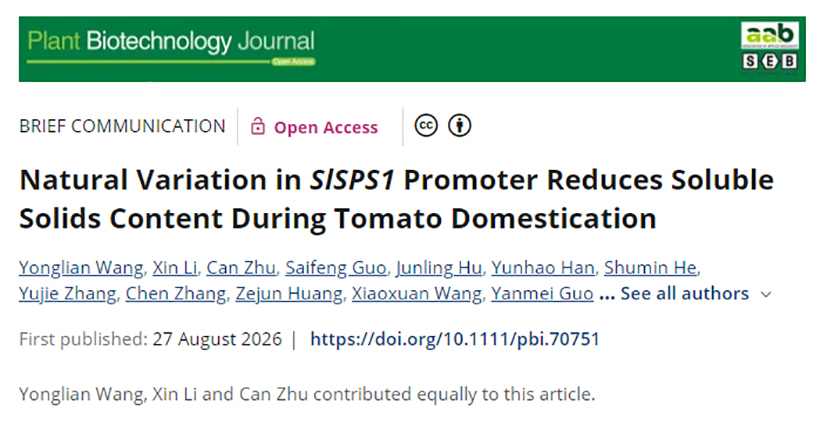
Recently, the tomato genetics and breeding team at the Institute of Vegetables and Flowers, Chinese Academy of Agricultural Sciences, published a research paper entitled "Natural Variation in SlSPS1 Promoter Reduces Soluble Solids Content During Tomato Domestication" in the internationally renowned journalPlant Biotechnology Journal. This study identified a novel quantitative trait locus (QTL), qSSC7.1, governing soluble solids content (SSC) from wild tomato germplasm, and confirmed that the causal gene is SlSPS1, which encodes sucrose phosphate synthase. The study found that a 1-bp insertion/deletion (InDel) variant in the promoter region of SlSPS1 is the core molecular basis underlying the differences in gene expression and sugar content between wild and cultivated species. This 1-bp InDel has experienced significant selection pressure during tomato domestication—the favorable allele associated with high sugar content was largely lost during early domestication and breeding improvement, and has only recently begun to recover with quality-oriented breeding efforts. This discovery provides a novel perspective on the genetic mechanisms underlying flavor quality degradation during tomato domestication, and offers a key target for precision breeding and gene editing to improve tomato fruit sugar content.
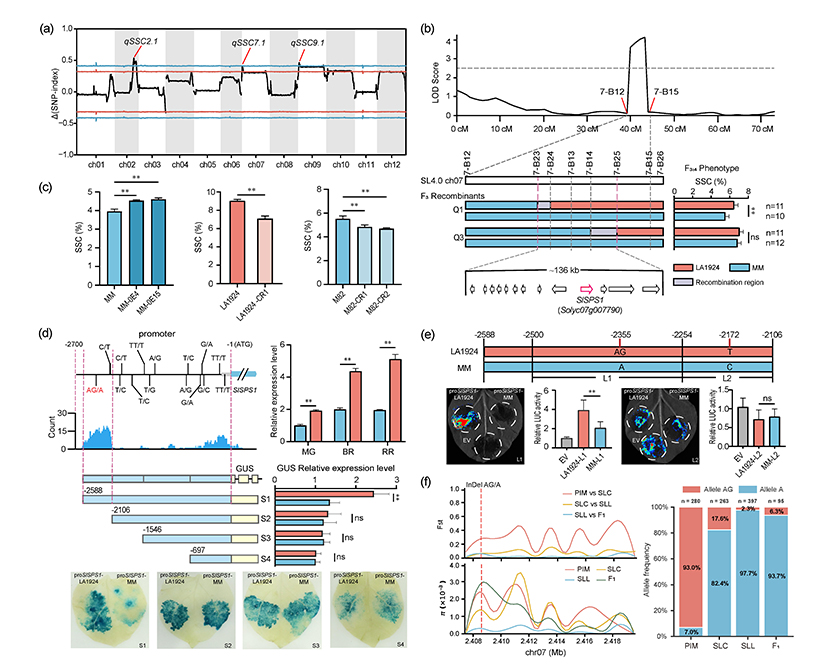
Through systematic evaluation of over 300 accessions of wild tomato germplasm (Solanum pimpinellifolium) across multiple years and locations, the research team identified an excellent accession, LA1924, with consistently high SSC. By constructing genetic populations, conducting fine mapping, and performing expression analysis, they pinpointed SlSPS1 (Solyc07g007790) as the most likely candidate gene; genetic transformation experiments further confirmed the function of this gene, revealing that SlSPS1 positively regulates fruit SSC without affecting fruit weight, thereby validating it as the causal gene forq SSC7.1.
To elucidate the genetic basis of differential SlSPS1 expression, the team systematically compared sequence variations in this gene and integrated tomato fruit ATAC-seq data, identifying two open chromatin regions in the promoter as core regulatory modules. Through transient expression assays with promoter deletion constructs and dual-luciferase reporter assays, the team ultimately identified a 1-bp InDel (AG/A) located at −2,355 bp as the core causal variant responsible for differences in SlSPS1 promoter activity.
Population genetic analysis of 1,035 re-sequenced tomato accessions revealed that during domestication and improvement from S. pimpinellifolium (PIM) to cherry tomato (S. lycopersicumvar.cerasiforme, SLC) and then to large-fruited cultivated tomato (S. lycopersicum, SLL), excessive selection for yield and appearance inadvertently eliminated key genetic loci such as the high-SSC AG allele that enhances sugar content, whereas modern breeding's renewed emphasis on fruit flavor quality has begun to reintroduce this favorable allele.
Most previously identified SSC-related genes function in "sink-side" processes such as sugar transport, unloading, or storage. This study, however, reveals for the first time a key regulatory factor, SlSPS1 , acting at the "source-side" sucrose synthesis interface, along with its natural promoter variation. The accumulation of soluble solids in tomato fruit requires integrated coordination from source organs (sucrose synthesis) to sink organs (sucrose unloading and storage). As a core initiation point in this pathway, the identification of regulatory elements in SlSPS1 provides a novel strategy for achieving source-level regulation of sugar content. The team proposed that combining optimization of SlSPS1 regulation with combinatorial editing of other sugar metabolism genes holds promise for synergistically enhancing fruit sugar content while maintaining metabolic homeostasis, thereby breaking the long-standing breeding bottleneck of incompatibility between high quality and high yield.
This study lists the Institute of Vegetables and Flowers, Chinese Academy of Agricultural Sciences, as the first and corresponding author affiliation. Professor Li Junming and Professor Liu Lei are co-corresponding authors; Master student Wang Yonglian, Assistant Professor Li Xin, and Assistant Professor Zhu Can are co-first authors. This work was supported by the Corps Science and Technology Program, the Agricultural Science and Technology Innovation Program of the Chinese Academy of Agricultural Sciences, and the Key Laboratory of Biology and Genetic Improvement of Horticultural Crops, Ministry of Agriculture and Rural Affairs.
Link to the original article:https://onlinelibrary.wiley.com/doi/10.1111/pbi.70751

 Chinese