Recently, the Chinese cabbage research group from the Institute of Vegetables and Flowers, Chinese Academy of Agricultural Sciences, published an online paper titled "Genetic complementation reveals distinct glabrous classes and a BrBPC2-BrGL1/BrGL3/BrTTG1 regulatory module controlling trichome development in Chinese cabbage" in the international horticultural journal 《Horticulture Research》(IF = 9.5, Q1). The study identified, through analysis of over a thousand breeding combinations, a phenomenon where "glabrous × glabrous offspring regain trichome phenotypes," systematically elucidated the genetic heterogeneity underlying the glabrous trait in Chinese cabbage, pinpointed key genes responsible for different types of glabrousness, and established a comprehensive regulatory network governing epidermal trichome development, encompassing upstream transcriptional regulation, protein interactions, and downstream gene responses.
The research team selected 9 hairless Chinese cabbage inbred lines for reciprocal crosses, resulting in a total of 72 F₁ hybrid combinations. Among them, 28 combinations showed hairiness, and 44 showed hairlessness. Genetic complementation analysis indicated that these phenotypically similar hairless materials could be classified into two different genetic complementation groups, suggesting that the hairlessness trait might be caused by different genetic defects. The research team further constructed two segregating populations, HW (hair) × HY (hairless) and Jin75 (hairless) × ShiF (hairless). Through fine mapping and sequence comparison, it was found that the hairless traits of HY and Jin75 were both related to the allelic variation of BrGL1 deficiency, while the hairless trait of ShiF was caused by the allelic variation of BrTTG1 deficiency. Since Jin75 and ShiF carry different allelic variations of gene defects and retain the normal allele of another gene, their hybridization can achieve genetic complementation in F₁, thereby restoring the formation of epidermal hairs. Further experiments using BrGL1 overexpression and gene editing of BrGL1 and BrTTG1 confirmed the key roles of these two genes in the formation of epidermal hairs in Chinese cabbage.
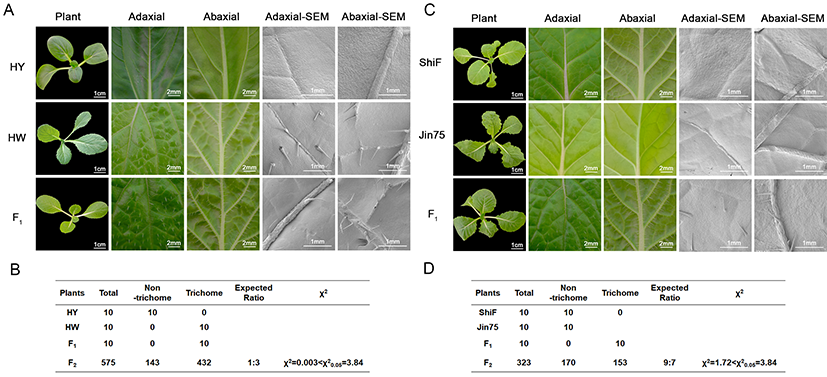
Figure 1 Genetic complementation of non-hairy materials of Chinese cabbage and phenotypic characteristics of segregating populations
Protein interaction analysis revealed that BrGL1 and BrTTG1 could not form a stable direct interaction, while BrGL3 could interact with both BrGL1 and BrTTG1 respectively and act as a core connecting factor to participate in the assembly of the epidermal hair development regulatory complex. The study also identified BrBPC2 as the upstream regulatory factor of BrGL1, confirming that BrBPC2 can bind to the promoter of BrGL1 and enhance its transcriptional activity. Combined with DAP-seq, gene expression analysis and dual luciferase assays, the study further determined BrETC1, BrETC3 and BrGL2 as candidate downstream genes responding to the BrGL1–BrGL3 regulatory combination, thereby preliminarily constructing a regulatory model of BrBPC2–BrGL1/BrGL3/BrTTG1 mediating epidermal hair development in Chinese cabbage.
This study revealed that the same phenotype of hairless Chinese cabbage materials might be caused by different genetic defects. It clarified the molecular basis of genetic complementation between different types of hairless parents and the recovery of hair on the offspring after hybridization. It expanded the understanding of the regulatory mechanism of epidermal hair development in Chinese cabbage and provided theoretical basis and genetic resources for the identification of allelic genes related to epidermal hair traits, the selection of hybrid parents, and molecular design breeding.
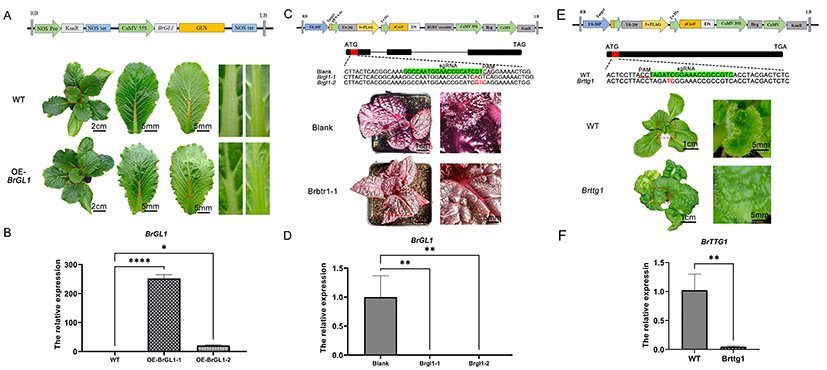
Figure 2 Functional verification of the BrGL1 and BrTTG1 genes
The Chinese Academy of Agricultural Sciences Institute of Vegetables and Flowers is the first completing unit of the paper. Associate Researcher Li Guoliang from the Institute of Vegetables and Flowers, Researcher Zhang Shujiang, and Researcher Zhao Zhizhong from the Institute of Vegetables of Shandong Academy of Agricultural Sciences are the co-corresponding authors. Doctoral student Wang Xiangsheng from the Institute of Vegetables and Flowers, Associate Researcher Wang Shubin from the Institute of Vegetables of Shandong Academy of Agricultural Sciences, and Postdoctor Dai Yun from the Institute of Vegetables and Flowers are the co-first authors. This research was funded by the National Key Research and Development Program (2022YFF1003000), National Natural Science Foundation of China (32502705), Beijing Rural Revitalization Agricultural Science and Technology Project (NY2401140224), National Major Vegetable Industry Technology System (CARS-23-A-14), and China Agricultural Academy of Sciences Innovation Engineering (CAAS-ASTIP-IVFCAAS).
Original link: https://academic.oup.com/hr/advance-article/doi/10.1093/hr/uhag388/8789389

 Chinese