Recently, the Soilless Culture Group of the Institute of Vegetables and Flowers, Chinese Academy of Agricultural Sciences (CAAS) published an important research paper online in Horticulture Research entitled “A SlERF4-SlTPP1 module enhances drought tolerance in tomato by increasing root:shoot ratio”. This study uncovered a novel SlERF4-SlTPP1 regulatory module that enhances drought tolerance in tomato by modulating the root:shoot ratio, providing a key theoretical basis and critical targets for molecular breeding of drought-tolerant crops.
Drought stress is one of the most devastating abiotic stresses, which severely restricts global crop productivity and threatens food security. Influenced by climate change, the frequency and intensity of drought events are increasing continuously. Improving crop drought resistance has become a key goal for the sustainable development of the horticultural industry. Increasing the root:shoot ratio is one of the central adaptive strategies employed by plants in response to water deficit. Previous studies have shown that the trehalose-6-phosphate phosphatase gene TPP plays a crucial role in plant drought responses, but its function in regulating the root:shoot ratio remains unclear.
In this study, we found that drought stress exhibits tissue-specific effects on the expression of the tomato SlTPP1 gene. Drought represses SlTPP1 expression in leaves but upregulates its expression in roots. Further investigation revealed that SlTPP1 increases the root:shoot ratio in tomato mainly through two pathways: (1) Overexpression of SlTPP1 elevates soluble sugar content in tomato roots and promotes root growth by upregulating the nocturnal-specific expression of root cell wall biosynthesis genes; (2) Overexpression of SlTPP1 inhibits the ethylene signaling pathway in tomato leaves, ultimately increasing the root:shoot ratio and enhancing drought tolerance.
To investigate how SlTPP1 responds to drought signals, the transcription factor SlERF4 was identified by yeast one-hybrid library screening. SlERF4 may act as a regulator of SlTPP1 gene expression. Subsequent dual-luciferase reporter assays and EMSA further demonstrated that SlERF4 could directly bind to the SlTPP1 promoter and negatively regulate its expression. In addition, drought stress showed tissue-specific effects on SlERF4 expression. Drought upregulated SlERF4 expression in leaves but downregulated its expression in roots. This expression pattern was exactly opposite to that of SlTPP1. SlERF4 mutant tomato plants were generated using the CRISPR/Cas9 system. The mutant plants showed elevated SlTPP1 expression in roots, increased root:shoot ratio, activated expression of root cell wall biosynthesis genes, and enhanced drought tolerance. Furthermore, drought regulated ethylene biosynthesis in an opposite manner in tomato roots and leaves. This pattern mediated the opposite expression profiles of SlERF4 and SlTPP1 in leaves and roots under drought stress.
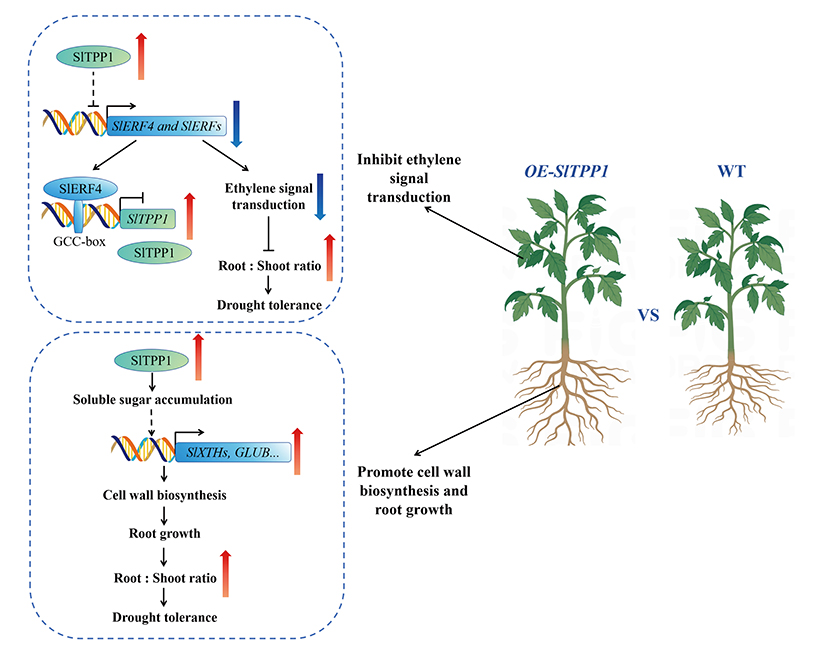
In summary, this study reveals a novel SlERF4-SlTPP1 regulatory module, which enhances drought tolerance in tomato by regulating the root:shoot ratio, providing an important theoretical basis and critical targets for molecular breeding of drought-tolerant crops.
Associate Professor Li Qiang, Professor Jiang Weijie, and Professor Yang Xueyong from the Institute of Vegetables, Chinese Academy of Agricultural Sciences (CAAS) are the corresponding authors of this paper. Postdoctoral Fellow Wang Heng, Dr. Chai Lin (now a postdoctoral fellow at the Beijing Academy of Agriculture and Forestry Sciences) who has graduated, and Professor Yu Hongjun are the co-first authors. This research was supported by the National Key Research and Development Program of China, the National Natural Science Foundation of China, and the China Agriculture Research System.
Original link:https://academic.oup.com/hr/advance-article/doi/10.1093/hr/uhag070/8503368?searchresult=1

 Chinese