Recently, the research team led by Professor Zhaojiang Guo and CAE (Chinese Academy of Engineering) Academician Youjun Zhang from our institute published a research article in Nucleic Acids Research (IF = 15.0), entitled “Microsatellite expansion redirects chromatin modifiers to confer insect resistance to Bt bioinsecticides”. The study reveals that expansion of an ATGT microsatellite in the promoter of the Bt receptor gene ABCC2 alters the binding preferences of histone-modifying enzymes, remodels local chromatin, and suppresses receptor expression, thereby conferring Bt resistance in the diamondback moth.
Bacillus thuringiensis (Bt) produces a variety of Cry and Vip insecticidal proteins valued for their efficacy, target specificity, and favorable safety and environmental profiles. Bt-based biopesticides and transgenic Bt crops are widely used in agriculture, delivering substantial economic and environmental benefits. However, the evolution of insect resistance threatens their long-term effectiveness. The diamondback moth, Plutella xylostella, is a major global pest of cruciferous crops and was the first insect reported to evolve field resistance to Bt biopesticides. It therefore provides an important model for investigating the molecular basis of Bt resistance.
Microsatellites are tandem repeats of short DNA motifs, typically one to six base pairs in length, and are also known as short tandem repeats or simple sequence repeats. Their highly variable repeat numbers have made them widely used genetic markers. Increasing evidence indicates that these sequences can also regulate gene expression, but their functional contributions to insect resistance remain poorly understood.
Previous studies established that reduced expression of the midgut Bt receptor ABCC2 contributes to resistance in diamondback moths. In this study, the researchers identified an expanded ATGT microsatellite in the ABCC2 promoter as a functional cis-regulatory element associated with reduced expression. Susceptible strains predominantly carried five repeats, whereas several resistant strains predominantly carried 34. Functional analyses showed that the expanded repeat suppressed transcription in a length- and orientation-dependent manner, while its deletion restored promoter activity. Replacing the five-repeat allele with 34 repeats in a susceptible genetic background using CRISPR/Cas9 reduced ABCC2 expression and conferred nearly 300-fold resistance to Cry1Ac, providing direct genetic evidence for the contribution of microsatellite expansion to resistance.
Mechanistic analyses revealed that the histone acetyltransferase Tip60 preferentially binds the short repeat, whereas the histone methyltransferase E(z) preferentially binds the expanded repeat. Short repeats were associated with increased histone H4 lysine 5 acetylation, accessible chromatin, and active ABCC2 expression. Expanded repeats were associated with E(z)/Polycomb repressive complex 2 (PRC2)-related histone H3 lysine 27 methylation, reduced chromatin accessibility, and repression of ABCC2. Functional perturbations further supported the roles of these histone-modifying activities in regulating receptor expression and Cry1Ac susceptibility.
Experiments spanning 15 generations also revealed coordinated changes under contrasting selection conditions. Cry1Ac selection in susceptible strains was accompanied by the appearance of longer repeats, reduced ABCC2 expression, and increased resistance. Conversely, withdrawal of selection from resistant strains was accompanied by the reappearance of short-repeat individuals, increased receptor expression, and partial recovery of susceptibility. These changes coincided with shifts in local histone modifications, linking population-level variation in repeat composition to chromatin state and resistance.
Together, the findings identify a cis-regulatory mechanism through which microsatellite length variation connects genetic variation with epigenetic regulation and insect resistance. The study expands our understanding of the regulatory functions of repetitive DNA and provides a basis for evaluating ABCC2 promoter microsatellite length as a candidate marker for resistance monitoring.
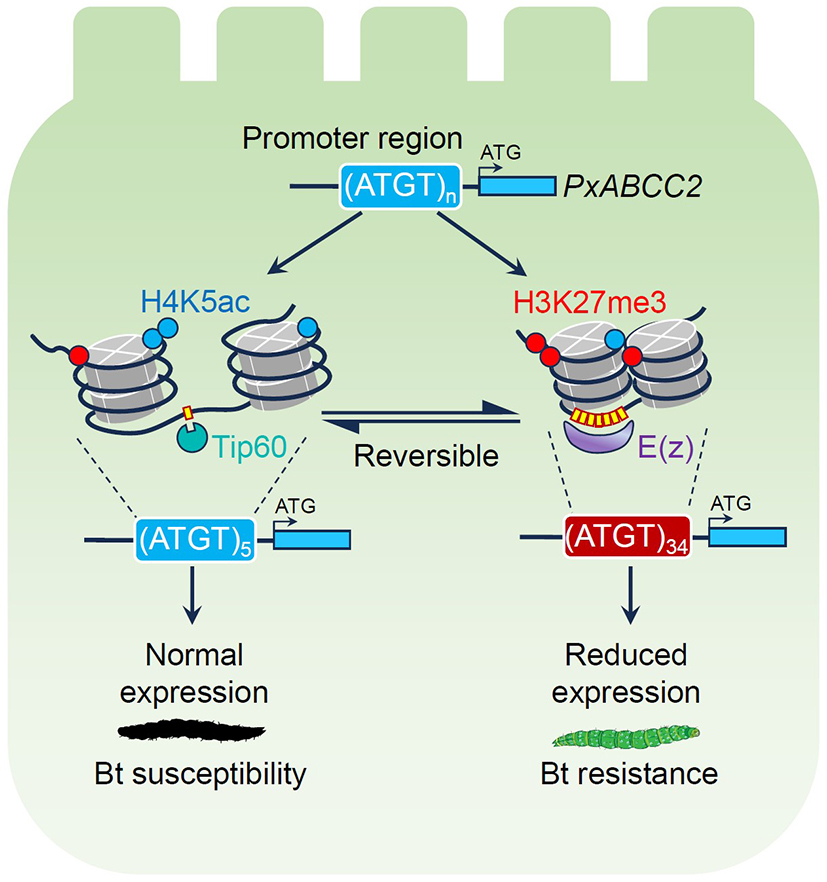
Figure. Microsatellite length-dependent chromatin regulation suppresses ABCC2 expression and confers Cry1Ac resistance in the diamondback moth
Chunzheng Ouyang and Kaiyue Sun, doctoral students at our institute, are the co-first authors of this paper. Professor Zhaojiang Guo is the sole corresponding author. CAE Academician Youjun Zhang provided important guidance for this study. This work was supported by the Innovative Research Group Program of the National Natural Science Foundation of China and the Agricultural Science and Technology Innovation Program of the Chinese Academy of Agricultural Sciences, among other funding sources.
Original link: https://academic.oup.com/nar/article/54/20/gkag1058/9002629

 Chinese