Recently, the Soilless Culture Team at the Institute of Vegetables and Flowers, Chinese Academy of Agricultural Sciences, published online in the classic international plant science journal Plant Physiology a research paper entitled “SlJRE4-SlTPP1 confers carbon starvation tolerance by inhibiting starch degradation in tomato leaves at night”. The study revealed the molecular mechanism by which SlJRE4, a transcription factor downstream of jasmonic acid (JA) signaling, directly activates the trehalose-6-phosphate phosphatase (TPP) gene SlTPP1 and thereby “applies the brakes” to slow nocturnal starch degradation in tomato leaves, enhancing plant tolerance to low-light-induced carbon starvation.
Under shade and low-light conditions, insufficient photosynthetic carbon assimilation readily drives plants into “carbon starvation”. Transitory starch accumulated in leaves during the day is the primary carbon source sustaining growth and metabolism at night, and its degradation rate must be precisely regulated—it should be largely exhausted by dawn to ensure a continuous carbon supply, while a premature “overdraft” of reserves must be avoided. Previous studies have shown that intrinsic mechanisms such as the circadian clock and protein complexes can finely tune the rate of starch degradation; however, how plants “apply the brakes” at the transcriptional level under low-light stress has remained unclear.
The team previously found that overexpression of SlTPP1 slows nocturnal starch degradation in tomato leaves under normal photoperiods. In the present study, photoperiod-gradient experiments further revealed that the inhibitory effect of SlTPP1 depends strictly on carbon availability: it was pronounced under short-day and day-neutral conditions (relatively limited carbon supply) but largely disappeared under long-day conditions (sufficient carbon supply). Mechanistically, SlTPP1 overexpression reduced leaf trehalose-6-phosphate (T6P) content and selectively suppressed β-amylase activity as well as the expression of the key starch-degradation genes SlBAM3.1 and SlBAM3.2, thereby slowing nocturnal starch degradation.
To dissect the upstream regulatory mechanism through which SlTPP1 responds to low light, the team performed yeast one-hybrid library screening and identified the JA-responsive ERF transcription factor SlJRE4. Yeast one-hybrid, dual-luciferase reporter and electrophoretic mobility shift assays (EMSA) collectively demonstrated that SlJRE4 directly binds the GCC-box cis-element located −860 to −816 bp upstream of the SlTPP1 promoter and activates its transcription. Overexpression of SlJRE4 recapitulated the phenotype of SlTPP1 overexpression: increased pre-dawn leaf starch content, reduced β-amylase activity and SlBAM3.1 expression, and decreased T6P levels.
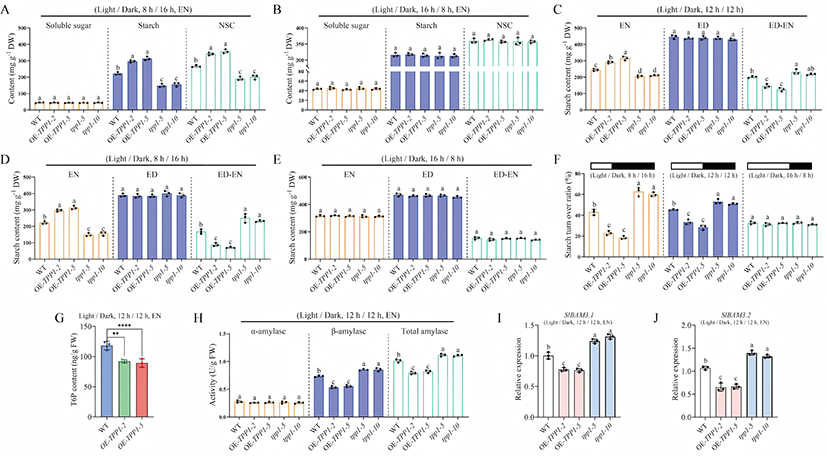
Figure 1 Overexpression of SlTPP1 inhibits nocturnal starch degradation in tomato leaves under short-day and day-neutral conditions
Further analyses showed that low-light treatment significantly upregulated the expression of JA biosynthesis genes including LOX, AOS, AOC, OPR and ACX, and increased the contents of JA and methyl jasmonate (MeJA) in leaves. Exogenous MeJA treatment likewise inhibited starch degradation and induced the expression of SlJRE4 and SlTPP1. In addition, SlTPP1 overexpression upregulated SlJRE4 at night, forming a positive feedback loop that further stabilizes this “energy-saving” state.
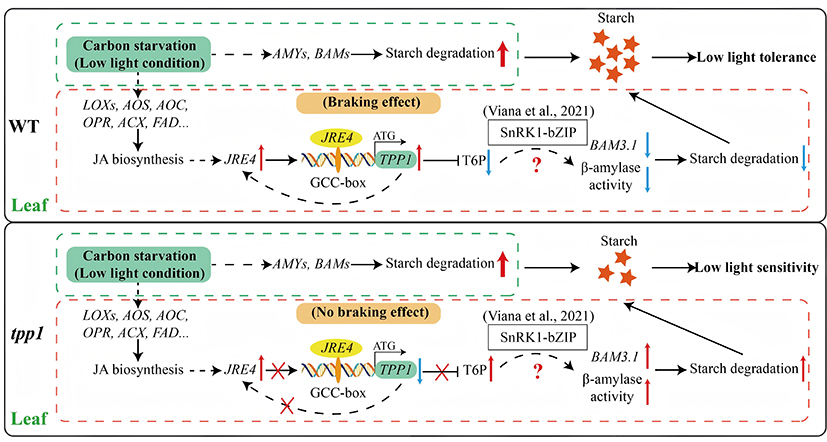
Figure 2 A working model of the SlJRE4-SlTPP1 module regulating nocturnal starch degradation in tomato leaves
This study delineated a complete transcriptional regulatory pathway—“low light—JA biosynthesis—SlJRE4—SlTPP1—inhibition of β-amylase and starch degradation”—and proposed a stress-triggered “brake” module for starch degradation. The findings not only expand our understanding of the functions of JA-responsive ERF transcription factors in primary carbon metabolism, but also provide a new theoretical basis and candidate genes for molecular breeding of tomato for low-light tolerance, carbon use efficiency and stress resistance.
The State Key Laboratory of Vegetable Biobreeding, Institute of Vegetables and Flowers, Chinese Academy of Agricultural Sciences, is the first affiliated institution of the paper. Dr. Lin Chai (currently a postdoctoral fellow at the Beijing Academy of Agriculture and Forestry Sciences), a former PhD graduate, and Associate Professor Heng Wang are co-first authors, and Professor Qiang Li and Professor Hongjun Yu are co-corresponding authors. This work was supported by the National Key Research and Development Program of China (2023YFD2300700, 2024YFD2300700), the China Agriculture Research System (CARS-21-B07), and the National Natural Science Foundation of China (32502804).
Original article: https://doi.org/10.1093/plphys/kiag796
Source: Vegetable Cultivation and Physiology Innovation Team

 Chinese