Recently, the team of Academician Zhang Youjun and Researcher Guo Zhaojiang from our institute was invited to publish the invited review paper "Plant strategies against herbivorous insects" in the international botanical authority journal Journal of Integrative Plant Biology. The paper systematically reviews the research progress in plant-insect interactions over the past two centuries, and for the first time proposes the "four magic weapons" of plants against herbivorous insects, namely physical defense, chemical defense, ecological modulation and behavioral defense. It emphasizes the coordination and synergy among the four, and points out the key research directions and areas for the future, providing an important theoretical basis for sustainable pest management.
For a long time, herbivorous insects have posed a serious threat to global agriculture, causing approximately 10%–20% of grain losses and 30%–40% of vegetable yield reductions annually, severely impacting food security and the sustainable development of agriculture. Although traditional control strategies centered on chemical pesticides are effective quickly, they are accompanied by problems such as environmental pollution, damage to non-target organisms and the evolution of pesticide resistance, making it difficult to meet the needs of modern sustainable agriculture. In the review, Researcher Guo Zhaojiang's team points out that during the hundreds of millions of years of evolutionary arms race between plants and herbivorous insects, plants have evolved highly complex and efficient natural defense systems against herbivorous insects, which can provide new ideas for agricultural pest control.
The paper systematically summarizes four core types of defense strategies:
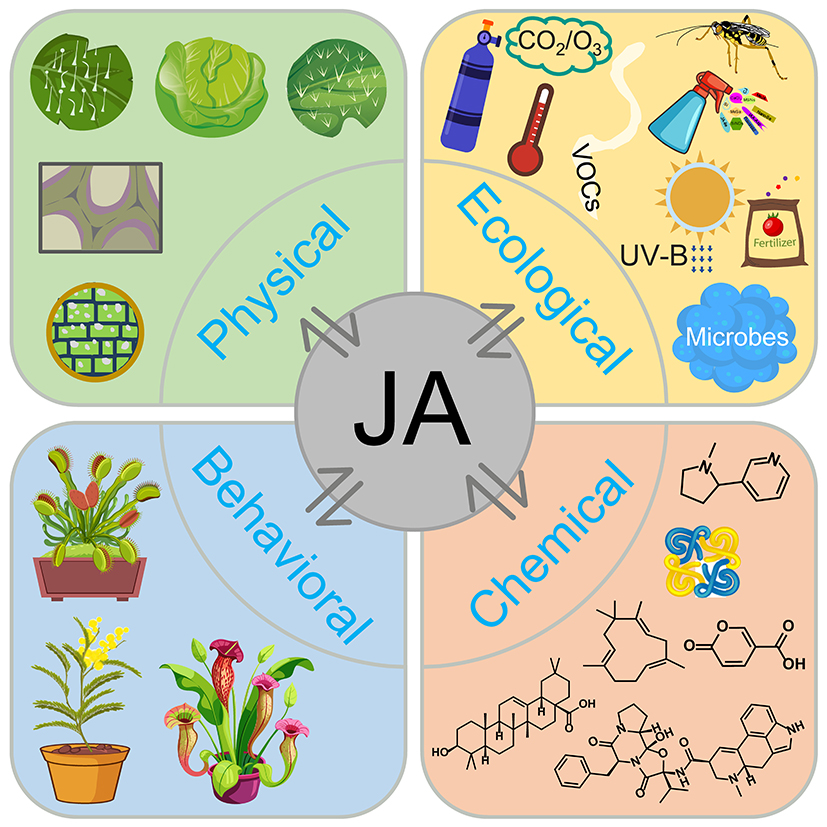
(1) Physical Defense: Plants form the first line of defense through structural features such as trichomes, thickened cuticles, lignin deposition and silicon deposition, which effectively hinder insect attachment, feeding and penetration. (2) Chemical Defense: Plants can produce secondary metabolites like terpenoids, phenolics, alkaloids, saponins and glucosinolates, as well as insecticidal proteins like protease inhibitors, which have repellent, toxic and digestive-disruptive effects on insects. (3) Ecological modulation Defense: When attacked by insects, plants can release volatile organic compounds (VOCs) that precisely recruit natural enemies like parasitic wasps, thereby forming an ecological defense system of "using insects to control insects," while also activating defense responses in neighboring plants. (4) Behavioral Defense: Plants can reduce the probability of insect recognition and feeding by adjusting growth rhythms, morphological structures and resource allocation strategies, achieving a dynamic balance between defense and growth. Moreover, these four defense mechanisms do not operate independently but achieve coordination and synergy mediated by signaling networks such as jasmonic acid (JA), forming a highly effective, multi-layered, multi-mechanism combined insect resistance system. Based on this, the paper identifies key future research directions including:(1) Systematically discovering and analyzing key insect resistance genes and their regulatory networks; (2) Constructing multi-layered synergistic insect resistance regulation models; (3) Promoting the integrated application of molecular design breeding and ecological control technologies; (4) Utilizing artificial intelligence (AI) technology to accelerate the discovery of insect resistance genes and precision breeding. These research efforts will help reduce reliance on chemical pesticides, delay the evolution of pest resistance, and provide new technological pathways for breeding highly insect-resistant crops. This review lays a theoretical foundation for understanding plants' natural insect resistance strategies and their application in agricultural biological control systems, promoting a shift from a "chemical control-oriented" approach to an integrated management model "supported by ecological and genetic resources." This is of great significance for enhancing crop insect resistance and achieving green agricultural development.
Postdoctoral researcher Zhu Liuhong, Dr. Yang Hanchi, and Dr. Li Peixuan from our institute are the co-first authors of this paper. Researcher Guo Zhaojiang is the corresponding author. Researchers Lv Honghao from our institute and Academician Zhang Youjun, an engineer at the Chinese Academy of Engineering, provided important guidance for this research. This work was supported by grants from the National Natural Science Foundation of China and the Agricultural Science and Technology Innovation Program of the Chinese Academy of Agricultural Sciences.
Original link: https://onlinelibrary.wiley.com/doi/10.1111/jipb.70209

 Chinese