Recently, the research team led by Researcher Zhaojiang Guo and CAE (Chinese Academy of Engineering) Academician Youjun Zhang from our institute published a review article in the internationally renowned entomology journal Annual Review of Entomology (IF = 16.9), entitled "The Regulatory Landscape of Insecticide Resistance Evolution in Arthropod Pests". This review systematically summarizes the diverse gene regulatory mechanisms and signaling pathways underlying insecticide resistance evolution in arthropod pests, and highlights their roles in regulating resistance-associated gene expression. It also discusses future directions in resistance monitoring, evolutionary prediction, and pest management.
The widespread use of insecticides has driven the evolution of diverse resistance mechanisms in arthropod pests, posing major challenges to agricultural pest management and public health. Studies have shown that insecticide resistance is not solely associated with mutations in insecticide target sites; the regulation of resistance-associated gene expression also plays an important role in the development and evolution of resistance.
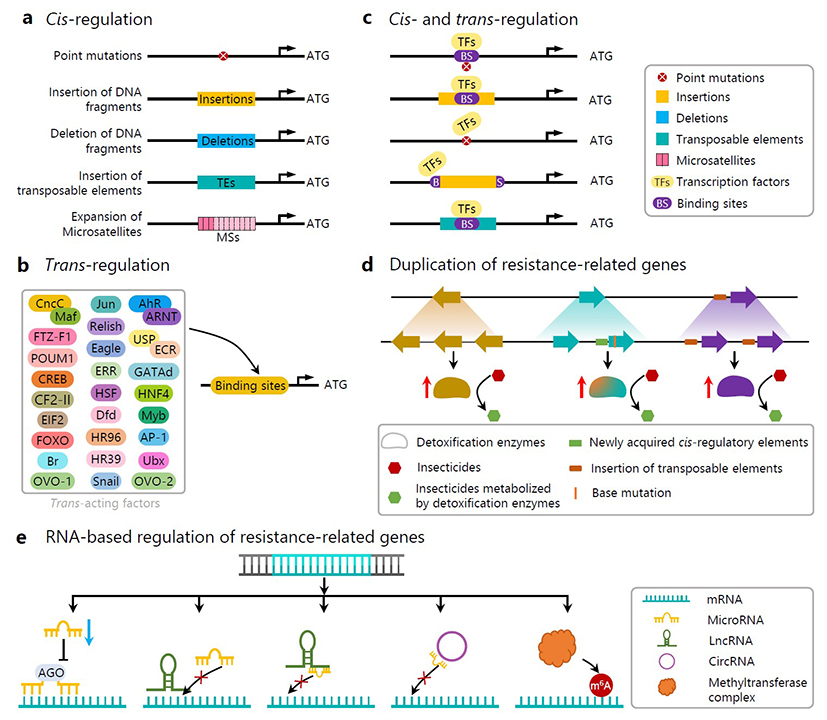
The regulatory mechanisms of insecticide resistance-associated genes can be broadly classified into five categories: mutations in cis-regulatory regions, such as promoters, directly alter gene expression; changes in the expression or activity of trans-regulatory factors, such as transcription factors, indirectly modulate resistance-associated gene expression; interactions between cis-regulatory elements and transcription factors coordinate gene expression; gene duplication promotes resistance by increasing gene copy number or generating new detoxification functions; and non-coding RNAs and RNA modifications regulate gene expression at the post-transcriptional level.
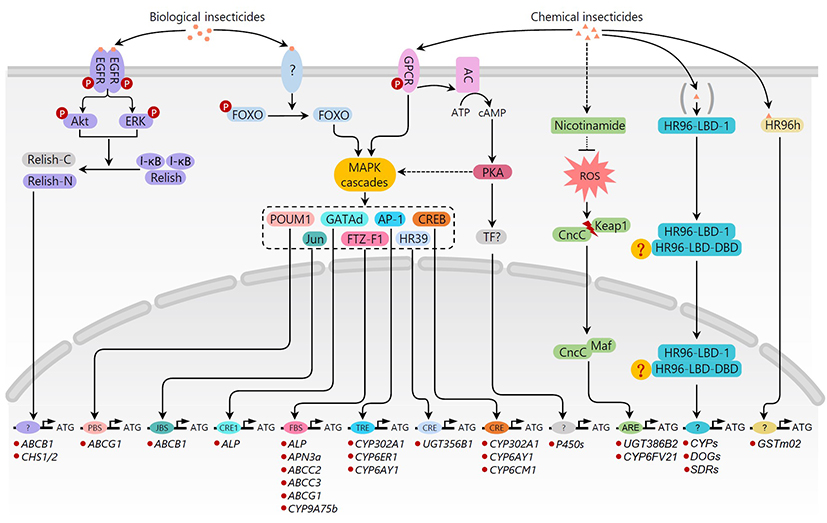
In addition, the review summarizes upstream signaling pathways involved in regulating resistance-associated genes, including EGFR/Akt/ERK, GPCR/MAPK, GPCR/AC/cAMP/PKA, FOXO/MAPK, ROS/CncC–Maf, and the nuclear receptor HR96. Among these pathways, MAPK signaling serves as a key hub linking upstream signal transduction to downstream transcriptional regulation. By coordinating the expression of multiple resistance-associated genes, it plays a critical role in insecticide resistance regulatory networks.
Dr. Zhaojiang Guo from the Institute of Vegetables and Flowers, Chinese Academy of Agricultural Sciences (CAAS), is the first and corresponding author of this review. Professor Wannes Dermauw from the Flanders Research Institute for Agriculture, Fisheries and Food (ILVO), Belgium; Professor Xuguo Zhou from the University of Illinois Urbana-Champaign, USA; and Professor Neil Crickmore from the University of Sussex, UK, are co-authors. CAE Academician Youjun Zhang provided important guidance for this study. This work was supported by the National Natural Science Foundation of China, the earmarked fund for the China Agriculture Research System (CARS), the Beijing Key Laboratory of Vegetable Pest Control and Sustainable Cultivation, and the Agricultural Science and Technology Innovation Program of CAAS.
Original link: https://www.annualreviews.org/content/journals/10.1146/annurev-ento-020926-092935

 Chinese